

Why Magento is Declining: Understanding the Fall of a Once-Dominant eCommerce Platform
Magento, once hailed as one of the most powerful and flexible eCommerce platforms, has been experiencing a noticeable decline in recent years. If you’re wondering why Magento is declining, you’re not alone. With shifting market dynamics, evolving customer expectations, and fierce competition from other platforms like Shopify and WooCommerce, Magento‘s dominance has come under threat.
In this article, we’ll delve into the core reasons why Magento is declining, supported by facts, user sentiment, and market trends. Whether you’re a store owner, developer, or digital marketer, understanding this shift is crucial if you’re planning your next eCommerce move.
The Future of PHP: Dying or Evolving?
A Brief Overview of Magento’s Rise
Before we explore why Magento is declining, it’s important to understand how it rose to prominence.
Magento was launched in 2008 as an open-source eCommerce platform offering unparalleled flexibility and customization. Developers loved its powerful architecture, while businesses appreciated the control it provided over every aspect of their online store. It quickly became the go-to platform for medium to large-scale businesses.
In 2018, Adobe acquired Magento for $1.68 billion, aiming to integrate it into the Adobe Experience Cloud. While this move was expected to strengthen the platform, many industry experts believe it was the beginning of its downfall.
Why Magento is Declining – Key Reasons
Let’s break down the reasons why Magento is declining in today’s competitive eCommerce environment.
1. Complexity and High Development Costs
Magento is not beginner-friendly. Setting up, managing, and scaling a Magento store requires significant technical expertise. Unlike platforms like Shopify, Magento is not a plug-and-play solution. It requires skilled developers, which leads to higher development and maintenance costs.
This complexity makes it less attractive to small and medium businesses. Many store owners are now opting for simpler platforms that offer faster time-to-market, lower costs, and fewer technical headaches. This shift in preference is one of the strongest reasons why Magento is declining.
2. Poor Performance Out of the Box
Another major reason why Magento is declining is its performance. Magento stores often face issues related to speed, scalability, and server optimization. Without expert-level optimization, Magento sites tend to load slowly, especially on shared hosting environments.
In a world where site speed affects SEO rankings and conversion rates, poor performance can be a dealbreaker. Shopify and WooCommerce provide better performance right out of the box, making them more appealing to businesses looking for efficient and responsive platforms.
3. Steep Learning Curve for Users
Magento has a very steep learning curve. Even experienced developers often face challenges navigating its complex admin panel and customizing its features. For business owners and marketers who aren’t technically inclined, using Magento can be overwhelming.
This is another core reason why Magento is declining. Many users don’t have the time or resources to invest in learning how to use a complicated system when user-friendly alternatives are available.
4. Adobe’s Focus on Enterprise Clients
Since the Adobe acquisition, Magento has become more focused on the enterprise market. Adobe Commerce (Magento’s enterprise version) is expensive and highly tailored for large organizations.
This shift has alienated Magento’s original base—small to medium-sized businesses. These businesses are now migrating to other platforms that cater more to their needs. This change in target audience is a significant factor why Magento is declining.
5. Security Concerns and Patch Management
Magento requires regular updates and patches to maintain security. Failing to update promptly can leave stores vulnerable to hacking attempts and data breaches. Managing these updates is not always straightforward and often requires developer intervention.
In contrast, SaaS platforms like Shopify handle all security updates behind the scenes. The growing concern over cyber threats and compliance issues is another reason why Magento is declining, especially among users who don’t want to manage security themselves.
6. Lack of Marketing Tools and Extensions
While Magento has a large library of extensions, many of them are expensive or outdated. Built-in marketing tools are also limited compared to competitors. Shopify and WooCommerce offer more modern integrations with marketing, CRM, and email tools.
The eCommerce world is becoming increasingly data-driven and marketing-focused. Magento’s inability to keep pace with marketing automation trends is another reason why Magento is declining.
7. Migration Challenges from Magento 1 to Magento 2
When Magento discontinued Magento 1 in June 2020, users were forced to migrate to Magento 2. However, this wasn’t a simple upgrade—it required a full rebuild, including data migration, theme redesign, and extension updates.
This led many store owners to reconsider their platform choice altogether. Instead of upgrading to Magento 2, many chose to switch to Shopify, BigCommerce, or WooCommerce. The migration fiasco is widely considered a major inflection point why Magento is declining.
Declining Market Share
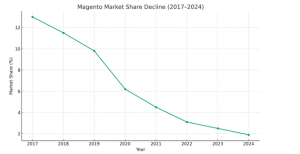
Recent statistics further emphasize why Magento is declining:
-
In 2017, Magento held over 13% of the market share among eCommerce platforms.
-
By 2024, its share has dropped to less than 2%, according to BuiltWith and W3Techs.
-
Shopify, WooCommerce, and Wix are rapidly gaining ground, leaving Magento far behind in adoption.
These numbers speak volumes about the changing preferences in the eCommerce ecosystem.
why Magento is declining
Developer Sentiment and Community Fatigue
Magento once had one of the most vibrant open-source communities. But over time, developer sentiment has shifted. Many developers express frustration with Adobe’s control, complex codebase, and lack of innovation.
Open-source contributors now find better opportunities and communities in other platforms. This dwindling community support is another major reason why Magento is declining, as it becomes harder to find passionate developers and contributors.
Magento is Still Relevant for Some Use Cases
Despite all these challenges, it’s important to note that Magento isn’t dead. For large enterprises with complex catalogs, custom requirements, and the budget for dedicated teams, Magento (Adobe Commerce) can still be a strong choice.
However, for the vast majority of eCommerce users looking for agility, affordability, and ease of use, Magento is no longer the preferred platform—explaining why Magento is declining in popularity.
Conclusion: What the Future Holds
Understanding why Magento is declining offers valuable insights for both store owners and developers. While Magento was once a revolutionary force in the eCommerce world, the landscape has changed dramatically.
Today’s businesses want fast, scalable, and easy-to-use solutions. Platforms like Shopify, WooCommerce, and BigCommerce are better aligned with modern user expectations. Magento’s complexity, cost, and strategic shift toward enterprise clients have collectively contributed to its fall from grace.
If you’re still on Magento, it might be time to re-evaluate your platform choice. Migrating now could save you significant time, money, and stress in the long run.
Frequently Asked Questions (FAQs)
Q1: Is Magento still a good platform in 2025?
Magento is still a strong platform for large enterprises with specific customization needs. However, for SMBs, the complexity and cost make other platforms more attractive, explaining why Magento is declining for mainstream use.
Q2: Why did Adobe’s acquisition impact Magento negatively?
Adobe shifted focus to enterprise clients, leaving smaller businesses behind. This strategic misalignment is one of the reasons why Magento is declining.
Q3: Is Magento open-source version still supported?
Yes, but the open-source version receives less attention compared to Adobe Commerce, contributing to why Magento is declining in community support and innovation.



Recent Comments